A.M. Skeffington

He systematized the evaluation of visual information processing. We have multiple visual skills, yet visual abilities have been boiled down to 20/20. He said 'This is not so,' and brought about a method of evaluation based on 21 different findings. These are evaluated not on the strength of one or another, but rather on the relationships among them.
- J. Baxter Swartwout, O.D.
Vision: Information processing in an illuminated environment.
- AM Skeffington, O.D.
Of what stuff is our vision made? “Vision is movement.” said Herrick, Harmon, and Sperry. “Vision is the elaboration of experience.” said Penfield. “Vision is prehension; it is reaching out, an output.” said Talbot, Ronchi and Halstead....
The vista of tomorrow depends almost wholly on the concepts of today. The broader the definition of vision, the wider will be the horizons of tomorrow.
- AM Skeffington, O.D. (In his presentation Linguistic Memory and the Visual Problem on the 'fourth circle' of his model of vision)
He who is unstable in visual space is insecure in his ego.
Vision is learned... Vision is motor... Vision is an emergent...
Perhaps some time in the future I will be sitting on a “pink cloud” and shall proudly tell my friends there – “That is one of my boys..."
The competent optometrist is necessarily aware of the permeability of the total organism and its effects on an impinging visual problem. It is easily understood how members of other disciplines, with their limited scope of interest, could fail to grasp the essence of the optometric “global” point of view wherein the optometrist does not confine himself to any facet of the total behavior but actually looks at the entire circuiting when considering the problem set before him.
- AM Skeffington, O.D. (in his final presentation)
Area 17 (V1) has been much touted as being the depositing site for the termination of the afferent phase of the visual-sensory input with some other not too clearly spelledout areas. From that point on, vague references to “mental” and “intellectual” are discussed. From this point on, there continues to be too little in the research. But as more and more is learned about the central nervous system, undoubtedly in time we will gain a reasonably precise “point to point” relationship between the retina and specific areas. Wilder Penfield made the startling statement, which a that time was a bomb shell when he said, “Apparently, every experience one ever has had is held within the stream of consciousness.” But where? Where is the “memory bank”?
As Renshaw said, “All we can do is to arrange conditions for learning so that he, by his continued efforts, may teach himself.” That is what we call Visual Training – the arranging of conditions for learning degrees of freedom in the visual process to absorb stress. As Ward Halstead said, “You cannot talk vision and intelligence, for they are one and the same things. When you investigate into vision, you are investigating into intelligence.”
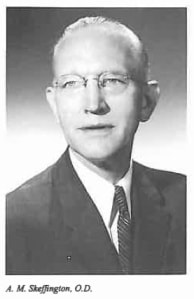
Arthur Marten Skeffington, O.D., D.O.S., L.H.D.
Arthur Marten Skeffington, known lovingly as "Skeff" cofounded the Optometric Extension Program in 1928 with E.B. Alexander.
Skeffington was a synthesizer...
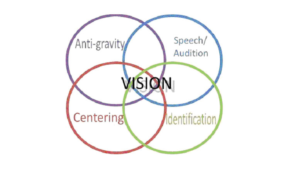
Skeffington is known as the father of Behavioral Optometry, and is remebered for his "Four Circles" model of vision.
The four circles consist of a Venn diagram Skeffington used to illustrate the integrative nature of the visual process...
The circles are:
1. Vestibular/Anti-gravity (where am I?)
2. Centering (where is it?)
3. Identification (what is it?)
4. Speech/Auditory (What do I call it, or how can I describe what it means to me?)
The area in the center where all four circles overlap, he identified as the emergent we call vision.
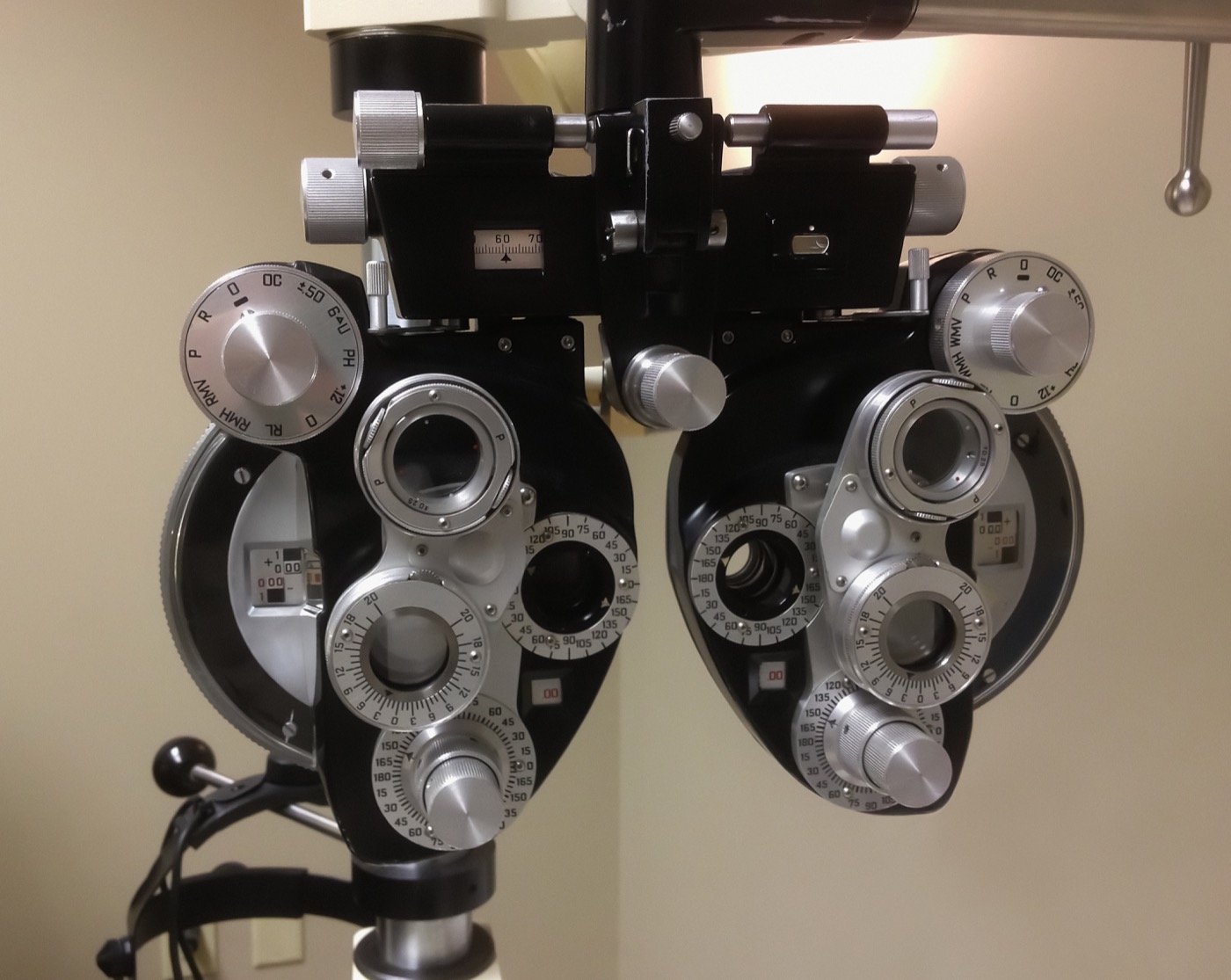
Skeffington developed a comprehensive 21 Point Eye Exam using the newly developed instrument called a Phoropter.
His unique method of analysis looked at the relationships between the findings to discover the patterns of visual function, and it is called Checking, Chaining and Typing.
Skeffington had a way of saying things that broke the listener out of the customary way of thinking... opening the minds of thousands of doctors over multiple generations.
OEP became and still is the largest postgraduate continuing education program for Doctors of Optometry.
When Skeff passed away in 1976 at the age of 86, my father was selected to take on the role of President of the OEP Foundation.
He was still serving as President when I was Trustee for SUNY Optometry, then Vice President and Editor, and finally President of AOSA, the American Optometric Student Association, in 1979-82.
For the full text of several of Skeff's last presentations, see reinventingoptometry.com/am-skeffington
He always came up with the right questions that provided insight both for himself and for his colleagues.
- Robert Kraskin, O.D.
Founder of the Skeffington Invitational Symposium on Vision (at which I have had the pleasure to attend multiple times, as well as to present my own model of sensory-motor integration while I was serving as founder of the Optometric Center of Tokyo)
What I want to find out is what this altered radiant energy does to bring about a response within this organism...
- A. M. Skeffington, O.D.
This quote is from the 1958 audio recording in the video below...
The greater the freedom of well-defined ranges, the greater the function.
This quote is from the 1958 audio recording in the video above... Skeff was memorable for many things, including traveling extensively by train, wearing spats, and saying "Optometry."
[*"The statements herein have not been evaluated by the Food and Drug Administration. This is not intended to diagnose, treat, cure, or prevent any disease."] T.D.C.